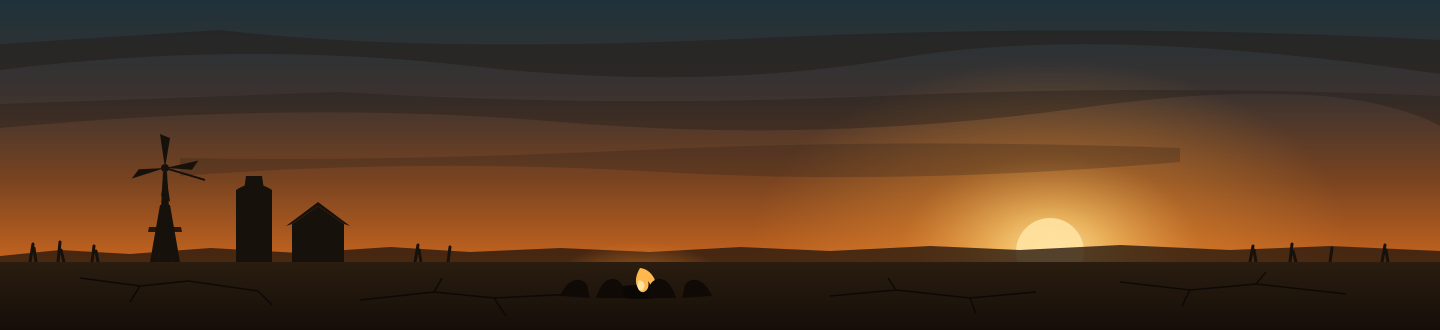
He'd promised the ending of the boom, and the valley held him to it. Mom sat close enough to touch his knee. She only does that when a story costs. Grandmother sat on his other side, which she never does, she has her chair, and I entered the seating before he said a word, because the family knew something the fire didn't yet. He sat the way he stands at iron he has already diagnosed, hands folded, and let the ring settle on its own. I ruled two pages ahead before he started, because a kept promise has a length to it, and I guessed at the length, and I guessed short.
It ended on a Tuesday, which offended me then and offends me now. A thing that size should not fit in a Tuesday.
You've heard the big version on the feeds all your lives, so I'll give it to you in one breath and be done with the newspaper part: the bet on the thinking machines had gotten so large that it wasn't in the market anymore, it was the market, a handful of companies holding up the whole tent, and underneath that, quieter, the coasts had been going uninsurable for years, whole shorelines' worth of mortgages standing on promises the insurance men had already privately stopped making. And underneath both, the fever sky of ’26 and ’27 had already knocked the yield tables sideways, so the paper was bleeding from the farm side too. Two rotten floors in the same house. In October of '29 they went through each other. The money that had come down on us like weather turned out to be weather: it moved on. That's the big version. I can't tell it any better than the historians, because I wasn't in the big version. I was in a small corner of it, and the small corner is what I have.
The week before, the screens went red and stayed red, and we joked about it, because we were engineers and the money side had told us the money side's job was worrying. Ruthie Okafor didn't joke. Ruthie spent that week doing something I didn't understand until later, which was printing. Schematics, pinouts, service procedures, the handshake documentation: reams of it, off to the side, after hours, a woman quietly filling banker's boxes in a company that had gone all-digital years before because paper wasn't seamless. I asked her what she was doing and she said, "Sentimental, I guess," and kept printing. Enter that, Del, and hold it. It comes back like the bookmobile.
The rest of us went on doing our jobs. The work was still on the benches even if the reasons for it were leaving. There was a sprayer boom in the fixture that week with a bad boot on one actuator, and I replaced that boot to spec, torqued and logged, on a machine that was never going to leave the yard again. I've thought about that boot since. I did the job right because right was the only thing in the building still hiring.
The jokes got worse by the day. Early in the week you could still laugh at them. By the end a man would tell one and nobody would, and he'd tell it again, a little quieter, as if the volume had been the problem.
And the meetings started coming off the calendars. Not canceled. Gone, like they'd never been called, and nobody whose job it was to tell you, because the somebody had gone the same way as the meeting. You'd stand in the doorway of a dark conference room holding your notes, and the room would let you figure it out at your own speed. I sat down in one of those rooms once, by myself, a minute or two. I couldn't tell you why.
[The fire cracked twice before he went on.]
The test yard didn't know. The demo plot behind the glass kept getting mowed, on its hour, clean passes, headlands squared, a machine keeping a lawn presentable for investors who were at that moment learning what their shares had turned into. Beautiful work. Nobody watched it.
The all-hands was a hologram. I want that detail remembered past all the others, because the future should know exactly how it was done. Eleven hundred of us, people who built machines you could kick, machines you could lean a ladder on, summoned to a soundstage projection of leadership at ten in the morning. And the person whose job was money used the phrase orderly wind-down four times. I know it was four because the man next to me (forty years with the company and its ancestors, a transmission man, hands like tree roots) kept the tally out loud, softly, the way you'd count church bells. "That's three." Pause. "That's four." At four he stood up, in the middle of the address, put on his cap, and walked out, and the hologram thanked him for his attention.
The details of my own arithmetic you can guess. The equity: paper, then not even paper. The pension: a letter promising a letter. The badge in my pocket: a rectangle. Sixteen years of the seeing of weeds, wound down, orderly, before lunch.
But here is what an orderly wind-down looks like from a cab seat in Kansas, because this is the part the hologram never had to see. It was October. The machines were in the fields. It was harvest, the two weeks the whole year exists for, and to save server costs the company no longer had, the sky got switched off mid-month. Every machine that phoned home heard silence, and took silence for no. Combines stopped in the row. Mid-pass. Grain tanks half full, heads down in the crop, at the exact hour of the year they had been built for, from Ohio to the Front Range, all at once, like a spell.
My work number was in the service files. For nine days my phone rang from area codes I'd never seen. A widow outside Broken Bow, Nebraska, running her late husband's operation on his notes, asking me to please just tell her which fuse, because it had to be a fuse, didn't it, something a person could hold? A young co-op manager in Manitoba, so polite it hurt, switching to French when the English gave out on him, and me with four words of Louisiana French from my mother's kitchen, and we got exactly nowhere in two languages.
The widow called back. She had found the fuse panel from his notes, and she read me every label on it over the phone, all of them, and I let her. Then I told her the truth: there was no fuse. The part that had quit was not on her machine and never had been; it was not anywhere she could drive to. The line went quiet, and then I heard, faint, the sound of her writing it down. She was putting it in his notes.
The young man in Manitoba tried me once more too. Not about the machine; he had given up on the machine. He wanted to know if I knew anybody, anywhere, who could come. He apologized before the question and after it, in both languages this time, and the apologies were all going the wrong direction.
And one call was nothing at all. An area code I'd never seen, a breath at the far end, and the click. Somebody out there heard a live voice answer a dead company's number and decided against saying his field out loud. I never learned the state.
Renata ran the kitchen underneath all of it. She'd hear the phone go down and start the next thing a shade louder than it needed, pans, water into a pot, so the house never once sounded like the phone. There was food where no food had been; I never heard a cupboard. She watched me the way she watches a load she has already counted.
[He stopped here. Grandmother's shoulder was against his. It had been there the whole time; the record just caught up.]
And the man outside Salina.
Three hundred acres of milo standing ripe, a locked machine, and weather coming; I could hear it in the wind on his end of the line. And he wasn't angry. That was the worst of it. He was courteous, the way you're courteous to a doctor when it's already too late, and he said: "Son, I'm not asking you to save the company. The company's dead, God rest it. I'm asking you to let me finish the field."
[Mom’s hand found his knee here. The record keeps the stop.]
And I said the sentence they had trained into us, the one the lawyers had blessed. I said: "Sir, I'm not authorized."
I built the sight in that machine. I knew its handshake the way you know a psalm. And I sat at my kitchen table in a dead company's t-shirt and let a field stand in Kansas because a ghost's lawyer might someday mind. He thanked me, thanked me, and hung up gentle, and I sat there with the phone in my hand for a long time, and Renata came in and looked at me and didn't ask, and I said, "I know how to fix it." And she said (you want to know when this family turned, all of it, everything since, the boneyard, the Chaplain, this valley) she said: "Then I'd start driving."
The day they walked us out, we could take one personal item. People took plants. Photos. Somebody took the good chair, and security pretended not to see, because Dennis on security had a box too. Ruthie took nothing at all (her boxes had been leaving in her trunk for two weeks, sentimental, I guess) and on my last pass through the lab I took a green diagnostic cable off my own bench. Serial number seven, from the first prototype run, the one whose pinout I'd drawn on a napkin nine years before there was a bench to keep it on.
I drove to Salina in November. Eleven hours, the cable in the glovebox like contraband, which, understand, it was; I had signed things, and the things had survived the company the way vines survive a house. I found the farm by his directions, water tower, grain leg, third mailbox, and the man met me in the yard and did not ask one question about paperwork, and we walked out to where the combine stood in the milo like a monument to itself, a quarter of the field already gone down flat under November.
My hands shook. I want that entered. The first orphan I ever woke, I woke scared: of the law, of being wrong, of the look on his face if the iron stayed dead. I pulled the panel. I found the pins. And when the log came up I stopped being scared, because the log wasn't a legal document, it was a machine asking a question, am I allowed to exist, and I knew the answer, and for the first time in my life there was no one left between me and giving it.
It caught on the second try. That sound in the cold (you all know that sound now, you've heard it up and down this valley) I heard it first in Kansas in November, and the man stood there in the noise with his hand on his cap and his eyes wet and furious about being wet, and he shouted over the diesel the only payment I took: "What do I owe you?" And I shouted back the new sentence, the one I'd worked out somewhere around Topeka, the one I've said ever since, the one this whole valley now runs on:
"Nothing. I'm not authorized." I let him hear it land. "But I'm able."
Then he climbed to his own seat and took the row.
We ran it into the dark. He had the machine's lights, and I put my truck at the turn row and aimed the beams down the standing milo, for whatever two more lamps were worth. I stayed on the ground. Understand: there was nothing down there left for me to do. The machine was awake and the machine was his, and my whole job was to stand in a stranger's stubble with my hands empty, listening to iron do the one job the whole mess had been keeping it from.
Every so often he went by up in the glass, lit low by his own gauges, and he sat younger than the man who had met me in the yard; don't ask me how a back and a hat brim say a thing like that in the dark. They say it. The dust came off the header and hung gold in the lights and went away south. In the yard he'd said we had until midnight, more or less. The wind came around north somewhere in the second tank, and the far fence line went first, white, then gone. He kept the rows. The snow came up the field toward the noise, and the noise kept eating.
We shut down for the night when the snow started riding the wind flat instead of falling. He came down the ladder slower than he'd gone up it, and stood by the machine while it ticked itself cool, and neither of us said anything.
We got what winter left us: two hundred acres of three hundred, his wife's supper afterward, and a friendship that lasted till the sickness took him in '32, and every November since, wherever I am, I lose an hour to that field.
That's the crash, children. The big version took the money. The version I carry took the word authorized and taught me its price, and gave me the other word in exchange. In this valley we say able. We mean something different by it. And that difference (not the cable, not the Chaplain, the difference) is the whole reason you can hear tractors from here.
Nobody put logs on for a while. Then Theo asked what happened to Ruthie Okafor, and Dad smiled for the first time all story and said, "Ask me at the machines fire," and Grandmother patted his knee once, like a stamp on a document, and the valley breathed out all at once. Entered with the tally at four, the tap at gentle, and the new word underlined: able. D.A.